Are you really interested about tis solution?
Take the next step. Book a free consultation and let's find the right approach for your business.
Your People Are Not Knowledge Workers — They Are Human APIs
Take a look at a typical day for your operations team. They start in the ERP, switch to the CRM for client data, open Excel to reconcile numbers, email the results to finance, then update the project management tool. The same information, touched five times, in five different places.
This is not a workflow — it is a workaround. And it creates three compounding problems:
Data Fragmentation: When the same record exists in five systems with five different update cycles, which version is correct? Nobody knows. Meetings devolve into arguments about whose spreadsheet is right — and the actual business decision gets delayed another week while someone reconciles the numbers.
Fragile Processes: Manual integrations depend on specific people remembering specific steps in a specific order. When that person is sick, on vacation, or leaves, the process breaks. Nobody else knows the workaround — because it was never documented, it was just "how Maria does it."
Hidden Cost: The average employee loses 4-6 hours per week to manual data transfer. For a 100-person company, that is 20,000-30,000 hours per year — the equivalent of 10-15 full-time employees doing nothing but copying and pasting. That is not overhead — it is a hidden payroll dedicated to work that should not exist.

What Changes When Your Systems Work as One
Data entered once propagates instantly to every system that needs it. No re-typing, no CSVs, no "I'll update it after lunch" delays that turn into permanent inconsistencies.
When someone asks "what's the real number?" — there is only one answer, and everyone sees it. Meetings become decision sessions, not reconciliation workshops.
Processes survive vacations, sick days, and resignations. The integration runs whether Maria is at her desk or on a beach — because the logic lives in the system, not in her head.
Your IT team stops firefighting integration issues and starts building strategic capabilities that move the business forward.
The CommIT Integration Architecture
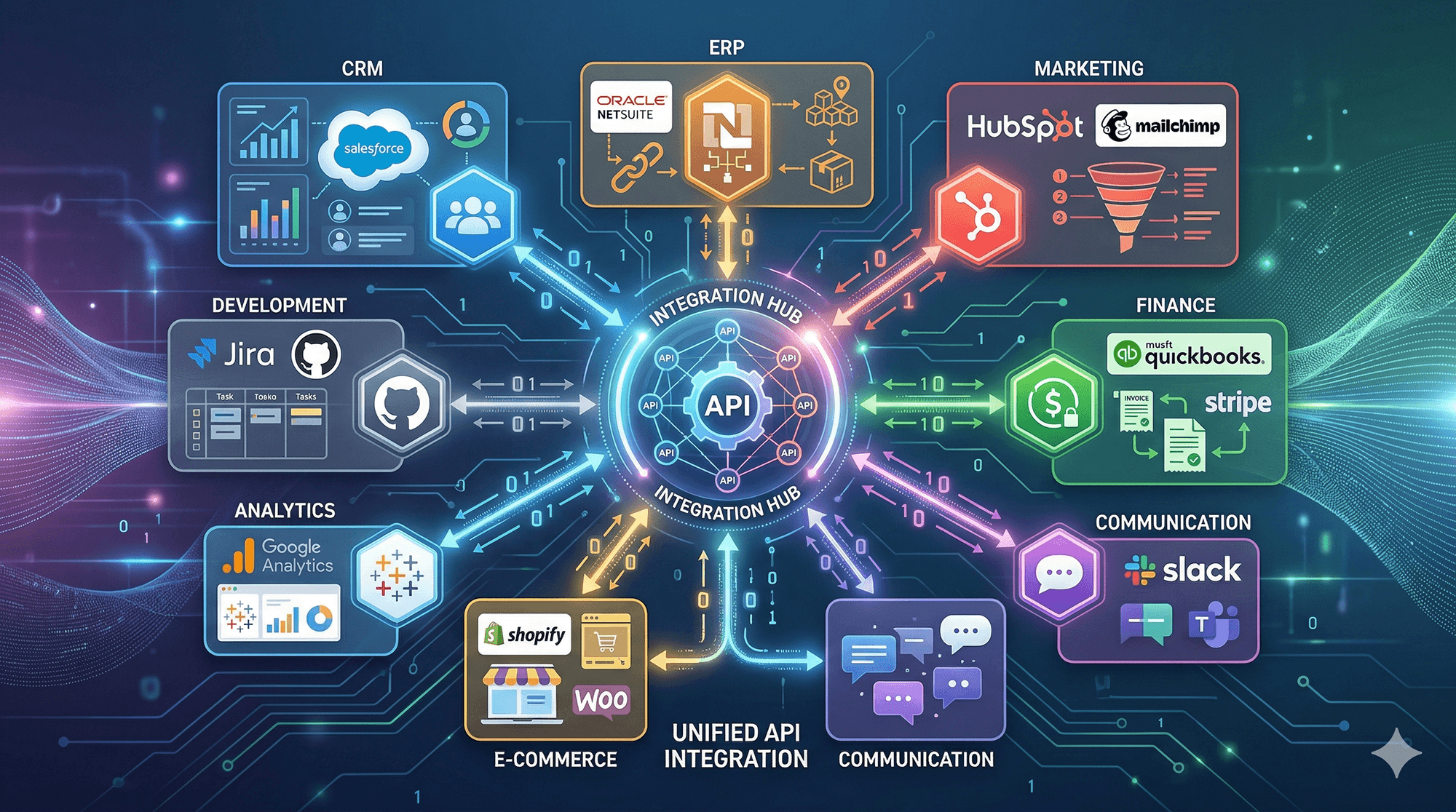
Point-to-point integrations between individual tools create a fragile web that breaks every time one system updates. Our approach builds a resilient middleware layer that orchestrates data flows across your entire tool landscape — adaptable, monitored, and maintainable.
API-to-API Connections: Direct integrations between your CRM, ERP, accounting, and project management systems using REST APIs and webhooks.
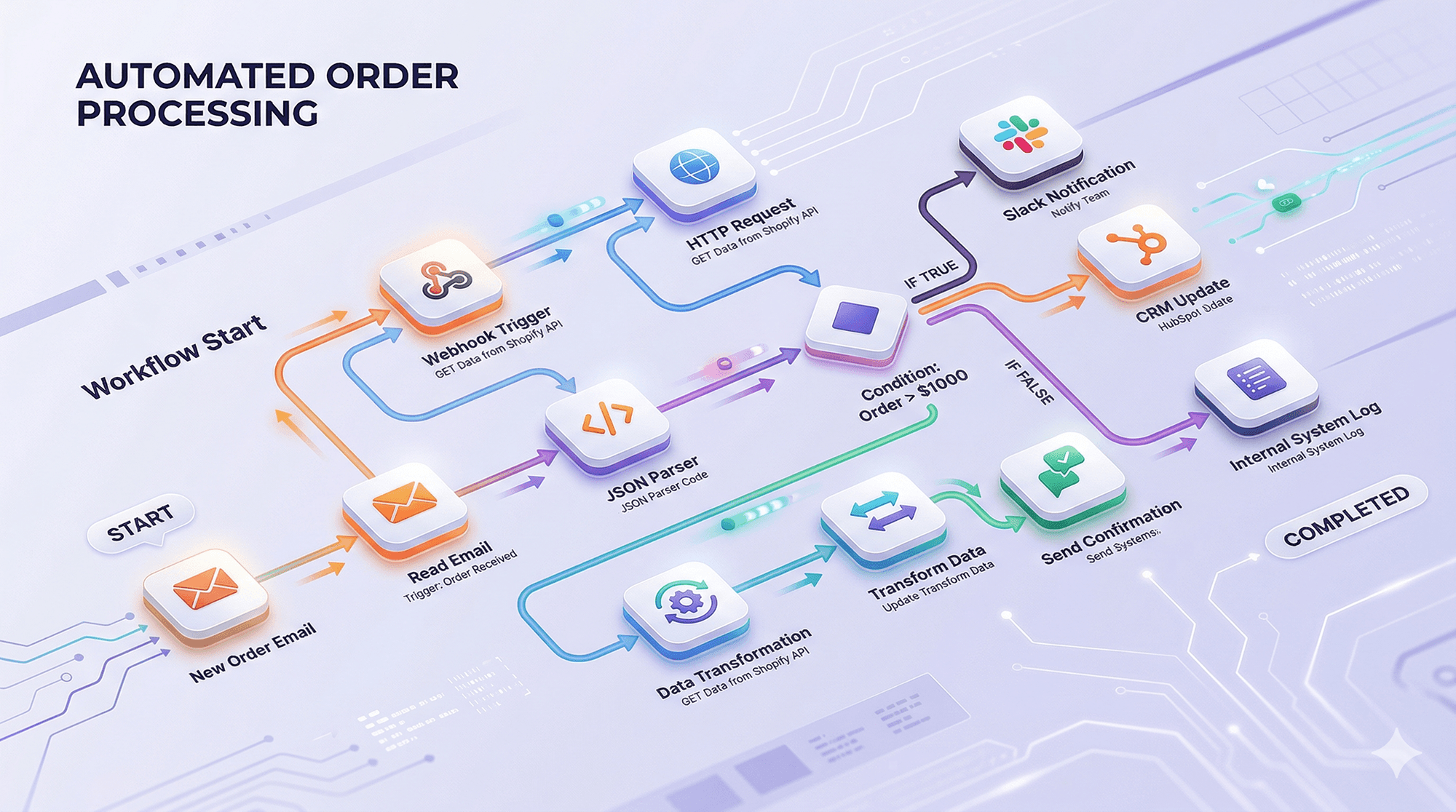
Middleware Orchestration: Complex multi-step workflows using n8n or custom middleware that transforms, validates, and routes data between systems automatically.
Legacy System Bridging: Even older systems without modern APIs can be integrated through database connectors or file-based exchange protocols.
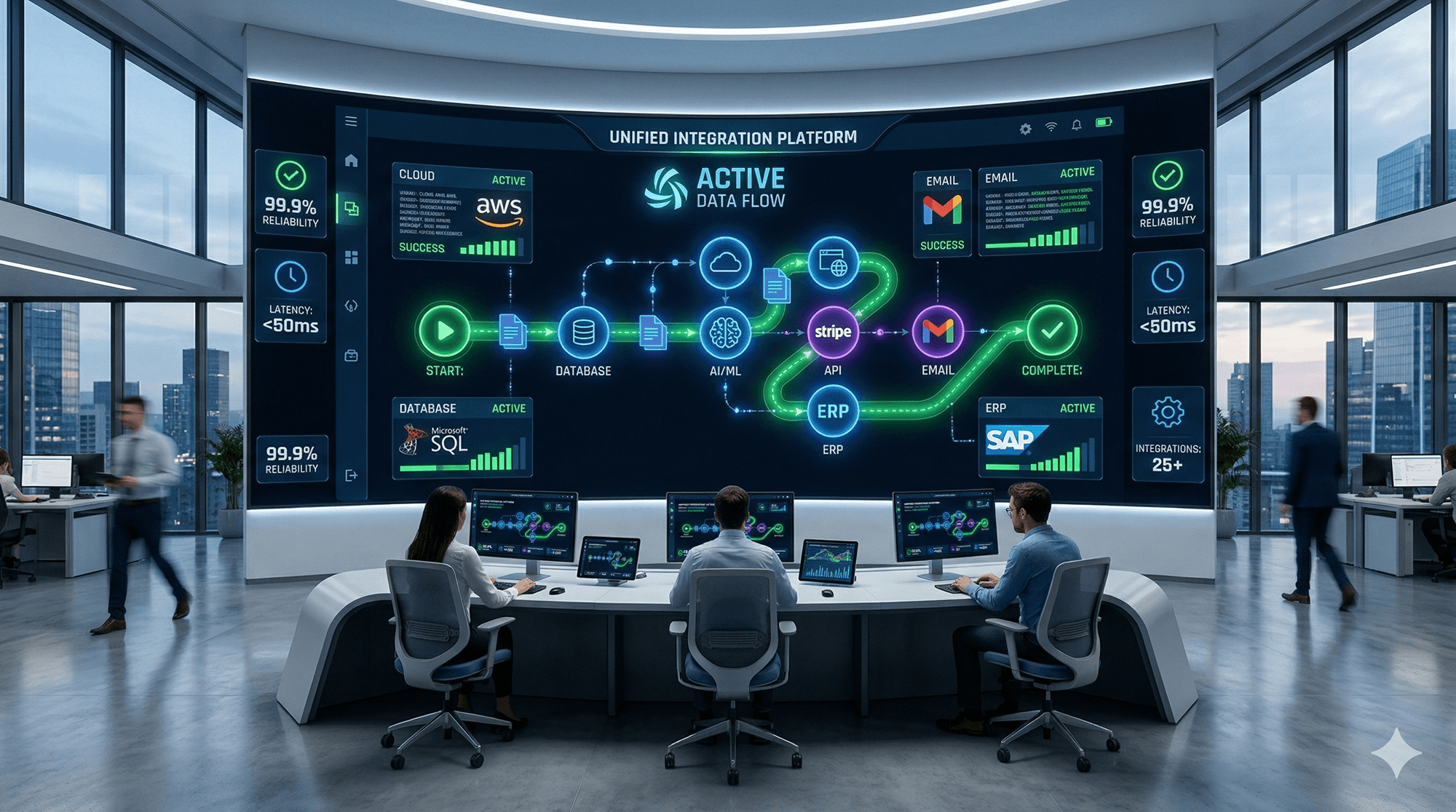
Real-Time Sync with Monitoring: Changes propagate instantly with built-in error detection and alerting — no silent failures, no data gaps discovered weeks later.
Real-World Impact
The Situation: A logistics company runs separate systems for order management, warehouse operations, fleet tracking, and client billing. Dispatchers manually cross-reference three screens to coordinate deliveries.
Before: 6+ hours daily on manual data transfer. Billing errors in 8% of invoices. Delivery updates delayed by hours.
After: Unified integration layer connects all systems. Billing errors drop below 0.5%. Clients see real-time delivery tracking without dispatcher intervention.
Why CommIT Smart?
We have built complex API integrations connecting CRMs, ERPs, and custom industry platforms for clients across logistics, manufacturing, and professional services. Our Partners API Integration project demonstrates our approach: resilient middleware, real-time sync, and zero-downtime deployment. Average integration project: 5 weeks to production.